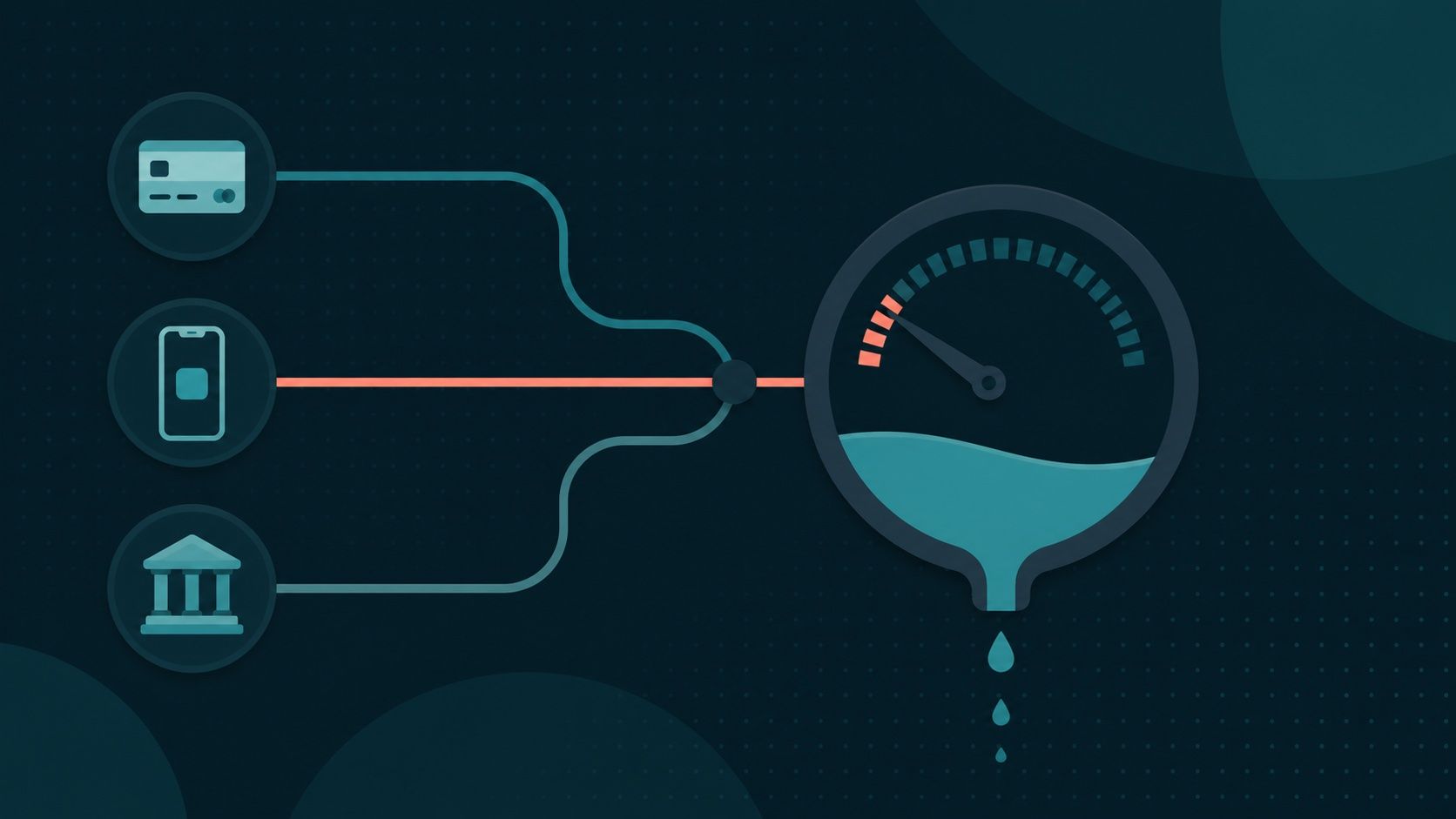
Buying Claude API Credits: Payment Routes, Prepaid vs Postpaid, and Why Cards Fail

The question behind "how do I buy Claude API credits"
Most people asking this have already tried the obvious path. They opened the Anthropic Console, reached the billing page, entered a card, and something went wrong — the card was declined, the country selector did not have the right option, or the account was created but never moved out of a zero-balance state.
That is a payment problem, not a pricing problem and not an access problem. Those are three separate layers, and mixing them up is why the same person can read a rate card, understand it completely, and still be unable to spend a dollar.
- Pricing is what a token costs. Covered in Claude API Pricing in 2026.
- Access is whether you can hold an account at all. Covered in Anthropic Claude API Access.
- Payment is whether money can actually move from your instrument to the balance. That is this article.
Prepaid credit and postpaid billing are not the same product
Anthropic's API bills in two modes, and which one you are in changes what "topping up" even means.
Prepaid credits. You buy a balance up front. Requests draw it down. When it hits zero, requests fail with a billing error until you add more. Nothing is charged after the fact.
Postpaid (monthly invoicing). You accrue usage and get billed for it later. This is generally gated behind an established account history or a sales conversation, and it is not what a new account starts on.
Almost everyone reading this is in the first mode. That matters practically: your balance is a hard stop, not a soft limit. A long-running agent job that exhausts the balance halfway through does not slow down — it starts returning errors mid-task. Auto-reload exists for exactly this reason and is worth turning on before you need it.
Why the card gets declined
When a payment fails at this layer, it is usually one of four things, and they have different fixes.
|
Symptom |
Likely cause |
What actually helps |
|---|---|---|
|
Card declined immediately, no bank SMS |
Issuer country not supported by the billing processor |
A card issued in a supported market |
|
Bank approved it, platform still rejects |
Billing address does not match the issuer's record |
Correct the AVS fields exactly as the bank has them |
|
Payment goes through, balance stays zero |
Charge captured against a different account than the API key belongs to |
Check which organisation the key sits under |
|
3-D Secure loop that never completes |
Challenge window blocked, often by an extension or strict privacy setting |
Retry in a clean browser profile |
The first row is the one that stops most people, and it is the only one with no workaround inside the platform. A virtual card issued through a service that does not map to a supported issuing country will fail the same way a domestic card does — the check is on the issuer, not on the number's format.
The three routes money actually takes
Once the direct path is off the table, there are three real options. They differ in who holds the billing relationship.
1. A first-party account with a supported payment instrument. You hold the account, Anthropic bills you directly. Cleanest arrangement, full access to console features, and the only route where your usage history accrues to your own organisation. Requires a payment instrument the processor accepts.
2. A cloud marketplace. Claude models are available through major cloud providers' model services, billed on the cloud account you already have. If your company already has a cloud billing relationship in a supported market, this route often clears the payment problem entirely, because the cloud provider — not Anthropic — is the merchant of record. The trade-off is a different API surface and region-by-region model availability.
3. A protocol-compatible gateway. A third party holds the upstream account and resells access over an OpenAI- or Anthropic-compatible endpoint. You top up with the gateway in whatever currency and instrument it supports, and point your SDK at its base URL. The trade-off is that you are trusting an intermediary with your traffic and your balance.
We wrote up how these routes compare for tooling specifically in Using Claude Code from China, and the mechanics of the third option in Claude API Proxy.
What to check before you top up a gateway
If you take the third route, the top-up is the moment you take on counterparty risk. A few things are worth confirming while the amount at stake is still small.
- Start with a minimum top-up. Treat the first payment as a test of the whole loop — pay, see the balance appear, make a real call, watch the balance move. Do not fund a quarter's usage on day one.
- Confirm the billing unit. Gateways variously bill on upstream token price, a multiplier of it, or a per-request unit. These are not comparable at a glance. Ask what one unit maps to.
- Check whether the balance expires. Some prepaid balances have a validity window. This is easy to miss and is the most common source of "my credit disappeared."
- Verify refund and residual-balance terms before paying, not after.
- Test streaming and long-context calls specifically. Basic completions working tells you very little. Streaming, tool calls, and long inputs are where compatibility gaps show up.
- Confirm which models the balance covers. Access to one model family does not imply access to the rest, and newer releases often land on a lag.
Reading your consumption after the money is in
Once you can pay, the balance drains faster or slower than expected, and the reason is usually one of two things.
Input dominates. For most agent and retrieval workloads, input tokens outnumber output tokens by a wide margin. A long system prompt resent on every turn is a recurring charge, not a one-off.
Caching is the main lever. Prompt caching changes the arithmetic on any workload with a stable prefix. If you are resending the same instructions or the same document set repeatedly, this is where the balance goes and where it can be recovered. The mechanics are in Claude API Pricing in 2026.
Set a low-balance alert as soon as you have one. Finding out the balance hit zero because a production job started erroring is an avoidable way to learn it.
Where ROIBest AI fits
ROIBest AI is a gateway of the third type: an OpenAI- and Anthropic-compatible endpoint you point an existing SDK or CLI at, with a prepaid balance and per-request usage records. If you are evaluating it, the checklist above is the one to run it through — start with a minimum top-up, confirm the billing unit, and test streaming and long-context calls before scaling up.
Summary
Buying Claude API access is a payment-layer problem with three routes: a first-party account, a cloud marketplace, or a compatible gateway. Which one fits depends on what payment instrument you hold and whether you need the billing relationship in your own name. Whichever you pick, top up small first, confirm the billing unit, and turn on a low-balance alert before a production job finds the floor for you.