Claude vs GPT API: The Differences That Actually Affect Your Integration (2026)

Most Claude vs GPT comparisons are benchmark tables. If you are choosing which model to ship, those matter. If you are writing the code that calls one — or moving code from one to the other — they mostly don't.
What matters then is a narrower question: where do the two APIs actually diverge, and what does each divergence cost you in integration work?
This is that list.
The request shape is closer than the docs suggest
Both APIs are HTTP endpoints that take a list of messages with roles and return generated content. If you have written against one, the other is recognisable immediately.
The differences that are real:
The system prompt lives in a different place. OpenAI's chat format puts it as the first message in the array, with role: "system". Anthropic's Messages API takes it as a system parameter alongside messages, not inside the array. This is the single most common thing to trip over when porting, and it is a five-minute fix once you know.
max_tokens is required on Anthropic's side. OpenAI treats it as optional with a model default. Anthropic requires it. Code ported in that direction fails immediately with a clear error, which is the good kind of incompatibility.
Message alternation is stricter. Anthropic expects user and assistant messages to alternate, and consecutive same-role messages need to be merged. If your application accumulates history loosely — appending several user turns before an assistant reply — that is fine on one side and an error on the other.
Multi-turn conversations are stateless in both. Neither API remembers your conversation. You send the history every time. If you are coming from an assistant-style abstraction, this is the thing to internalise before estimating token cost.
Where the token accounting differs
Both bill on input and output tokens, but the shape of the bill differs in ways that matter more than headline per-token rates.
Caching works differently. Both offer a discount for reusing a stable prefix, but they are configured differently — Anthropic uses explicit cache breakpoints you place in the request; OpenAI's applies automatically to matching prefixes. If a long system prompt is a large share of your traffic, this is usually a bigger lever than the rate difference between the two models.
Reasoning and thinking tokens are output tokens. On both sides, extended reasoning is billed as output. A model that thinks more costs more, and the cost does not appear in the visible response length. Budget from the usage record, never from the string length of the reply.
Batch processing is discounted on both. Roughly half price, in exchange for asynchronous delivery. If any part of your workload is not user-facing, this is the largest structural discount available and it is frequently left on the table.
The compatibility layer, and where it leaks
Because the OpenAI request format became a de facto interface, a large number of providers — including gateways and proxies — accept OpenAI-shaped requests and route them to whatever model you name. That is how most teams end up calling both models through one client.
This works well for the core path: chat completions, streaming, basic parameters. It is worth knowing where it usually stops being exact:
- Streaming event shapes differ underneath. A compatible endpoint normalises them, but if you parse raw events rather than using an SDK, verify against the endpoint you are actually calling.
- Tool/function calling has converged in concept but differs in the exact JSON around it. Anything that inspects the raw tool-call structure needs testing per provider.
- Provider-specific parameters — extended thinking configuration, cache breakpoints, certain sampling controls — usually have no OpenAI-format equivalent, and get dropped silently by a translation layer rather than raising an error.
That last one is the failure mode worth designing against: a parameter that silently does nothing is harder to notice than one that errors.
Switching between Claude and GPT with one API endpoint
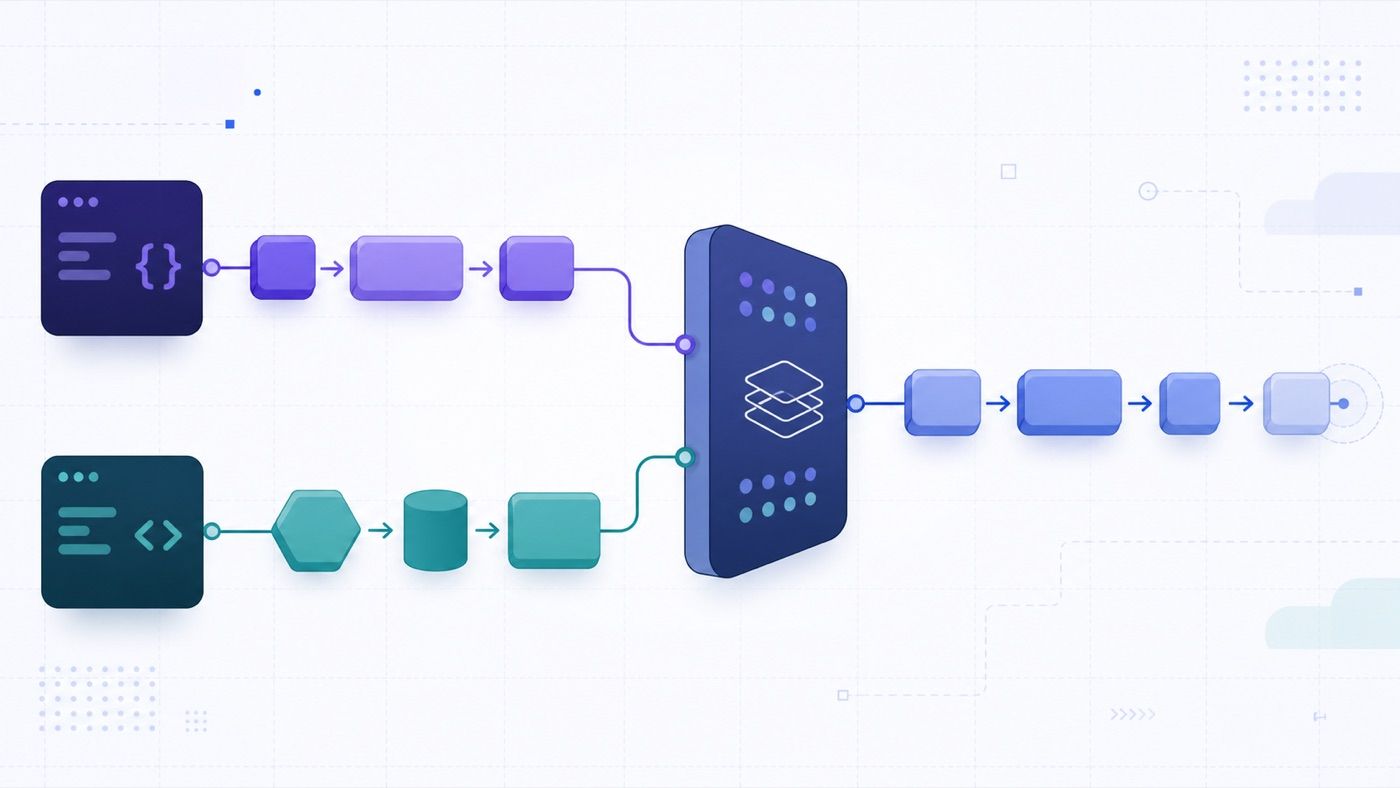
Yes, this is what an OpenAI-compatible gateway is for. You configure one client with one base URL and one key, and the model field on each request decides whether it goes to Claude or to GPT. Switching becomes a change to a string, not a change of SDK or account.
In practice the setup has four parts:
- One base URL, one credential. The client is configured once and the gateway holds the provider-side accounts. How the base URL swap works is covered in the OpenAI-compatible base URL guide.
- Model name per request. Keep the model string in configuration rather than hard-coded, so routing a workload from one family to the other is a config change, not a deploy.
- Fallback is your decision. Retrying against the other provider on errors is only safe if the prompt has been tested on both. The gateway normalises request shape (system prompt position, max_tokens, alternation), but not output style or tool-call behaviour.
- Provider-specific options sit outside the common path. Cache breakpoints, thinking parameters and similar options may be dropped or passed through depending on the gateway. Check its documentation and confirm the parameter actually takes effect.
If your code already uses the OpenAI SDK, using the OpenAI SDK with Claude walks through the exact changes, and what an OpenAI-compatible API does and does not cover explains the limits of the compatibility layer.
Choosing between them, as an integration decision
Setting model quality aside — which is workload-specific and changes with every release — the integration-level considerations are:
- If you already have OpenAI-shaped code, reaching Claude through an OpenAI-compatible endpoint is the smallest change: a base URL and a model name. Native SDK migration is a larger change and buys you the provider-specific features listed above.
- If you need extended thinking or explicit cache control, use the native API. Those are exactly the parameters compatibility layers drop.
- If you want to switch between models per request — routing by task type, or failing over — a single compatible surface in front of both is what makes that cheap, which is what a gateway is for.
There is no requirement to pick one permanently. The interesting property of the compatible-format ecosystem is that model choice becomes a runtime decision rather than an architectural one.
Frequently asked questions
Can I use the OpenAI SDK to call Claude?
Yes, through an OpenAI-compatible endpoint — you set the base URL and the model name, and the rest of your client code is unchanged. Provider-specific parameters will not be available through that path.
What breaks most often when porting from GPT to Claude?
The system prompt position, the required max_tokens, and strict user/assistant alternation. All three fail loudly rather than silently, which makes porting less risky than it sounds.
Is one meaningfully cheaper than the other?
Comparing headline per-token rates is the least useful way to answer this. Caching configuration and batch usage typically move the bill more than the rate difference between comparable tiers.
Do I need separate accounts for each?
Not if you call both through a single compatible gateway — ROIBest AI is one such endpoint, exposing both behind one OpenAI-compatible surface. Going native for each means managing each provider's credentials separately.
Is there a platform that lets me switch between Claude and GPT with one API endpoint?
Yes. OpenAI-compatible gateways, ROIBest AI among them, expose Claude and GPT models behind a single base URL and key, so switching is a change to the model name on each request. Test provider-specific parameters separately, since not every one passes through.
The short version
At the integration layer the two APIs are far more alike than different. The real divergences are the system prompt's position, required max_tokens, message alternation, and how caching is configured — plus the fact that compatibility layers drop provider-specific parameters quietly.
Pick based on which of those you need, not on a benchmark table that will be stale next quarter.