LLM API Gateway: What It Does, When You Need One, and What to Check

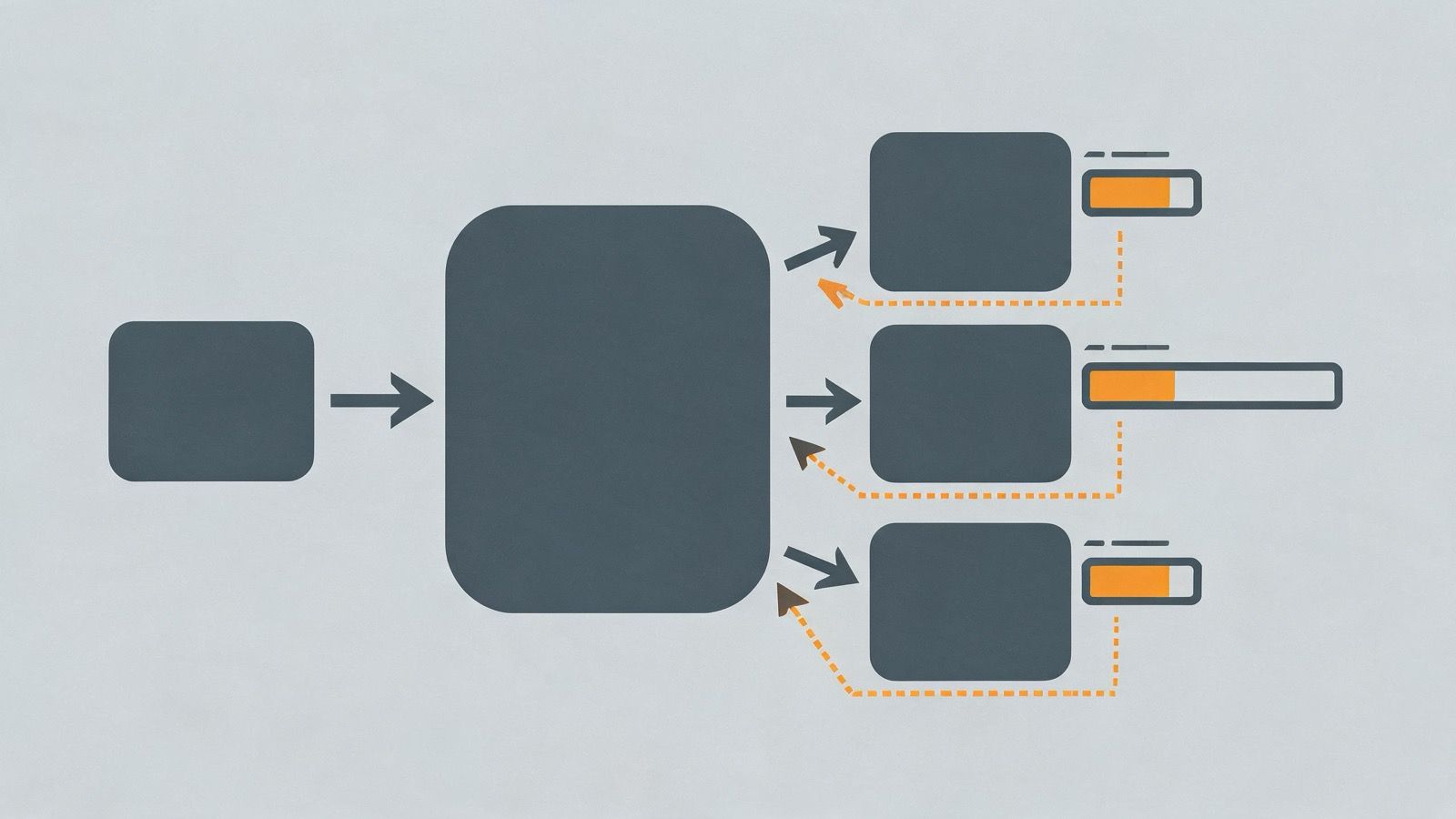
An LLM API gateway is a service that sits between your application and one or more model providers. Your code talks to a single endpoint with a single credential; the gateway decides which upstream model handles the request, enforces quotas, records what was spent, and returns the response in the shape your client already expects.
It is infrastructure, not intelligence. A gateway does not make model output better — it makes the operational side of calling models predictable: keys, limits, failover, and accounting.
What a gateway actually does
One endpoint, many providers. The client sets a base URL once. Adding, replacing, or A/B-testing a model becomes a server-side configuration change instead of a deployment.
Credential separation. Application code holds a gateway key, not the provider key. When a key leaks or an employee leaves, you rotate one scoped credential rather than the root credential shared by every service.
Routing and fallback. Requests can be routed by model name, by tenant, or by cost tier, and a failed or overloaded upstream can fall back to a second one. Whether the fallback is automatic and whether it preserves streaming are the two details that separate implementations.
Quotas and rate limits. Per-key spend caps, request-per-minute limits, and expiry dates let you hand a key to a team or a customer without handing over your whole budget.
Usage accounting. Token counts and cost attributed per key, per model, and per time window — the thing provider dashboards give you only in aggregate.
Observability. Latency, error rates by upstream, and retry counts. Without this, "the model is slow today" is unfalsifiable.
Protocol translation. Most gateways expose an OpenAI-compatible surface so existing clients work unchanged. What that compatibility does and does not cover is worth understanding before you rely on it — see what an OpenAI-compatible API is.
Gateway, proxy, or SDK router?
The three terms overlap in casual use, and the distinction is mostly about where the logic lives.
|
|
Runs where |
Typically handles |
Good when |
|---|---|---|---|
|
SDK-level router |
In your application process |
Model selection, retries |
One service, one team, no cross-app policy |
|
Proxy |
Between client and provider |
Request forwarding, header rewriting, sometimes auth |
You need reachability or credential hiding, little else |
|
Gateway |
Standalone service |
All of the above plus quotas, accounting, multi-tenant keys, observability |
Several services or teams share model access |
The narrower case — one client, one provider, mainly about reachability and key hiding — is covered in Claude API proxy.
When you probably do not need one
- A single application, a single provider, one key, and no need for per-team accounting.
- Latency budgets so tight that an extra network hop is unacceptable and you have measured that it matters.
- A prototype. Adding a gateway before you know your traffic shape is optimising a problem you do not have yet.
The honest trigger for adopting one is usually organisational, not technical: a second team needs access, or someone asks which project spent what.
What to check before choosing
Protocol compatibility, in detail. "OpenAI-compatible" is a spectrum. Verify the specific fields you use — tool calling, structured outputs, system prompts, multimodal inputs, stop sequences — rather than assuming the whole surface.
Streaming behaviour. Does the gateway stream tokens through, or buffer the full response? Buffering turns a responsive UI into a spinner, and it is the most common regression when a gateway is introduced.
Timeout and retry semantics. Ask what the gateway does on an upstream 429 or 500: retry with backoff, fail over, or return the error. Silent retries on non-idempotent requests can double-charge you.
Key scoping. Per-key model allowlists, spend caps, and expiry. Handing out keys is only safe if you can bound them — see setting quotas and expiry on API keys.
Logging and data handling. Whether prompts and completions are stored, for how long, and whether that can be turned off. This is usually the deciding factor for anything touching user data.
Latency overhead. Measure it against a direct provider call, on your own network path, with your own payload sizes. Vendor-published numbers rarely reflect your geography.
Failure transparency. When a request fails, can you tell which upstream failed and why? A gateway that flattens every error into a generic 500 makes incidents much longer.
Verifying a gateway in three calls
Before wiring an application to a new endpoint, three curl calls answer most questions:
- List models — confirms the credential works and shows which model identifiers this gateway actually accepts.
- A non-streaming completion — confirms the request and response shape match what your client expects, including the usage fields you plan to bill against.
- A streaming completion — confirms tokens arrive incrementally rather than in one buffered block at the end.
If all three behave, most client libraries will work after a base-URL change. If the third one buffers, you will notice in production, not in tests.
ROIBest AI provides an OpenAI-compatible endpoint with per-key quotas and expiry, usable from Claude Code, Codex, and standard OpenAI client libraries; the setup guide covers the two environment variables involved.
Frequently asked questions
What is an LLM API gateway?
A service between your application and model providers that exposes one endpoint and one credential, then handles routing, fallback, quotas, usage accounting, and logging on the server side.
Is a gateway the same as a proxy?
Not quite. A proxy mainly forwards requests and can hide credentials. A gateway adds policy: per-key quotas, spend caps, multi-provider routing, and usage attribution.
Does a gateway add latency?
It adds a network hop, so some overhead is unavoidable. Whether it matters depends on your latency budget and where the gateway is hosted relative to your application — measure it on your own path rather than trusting published figures.
Will my existing OpenAI client work with a gateway?
Usually, if the gateway exposes an OpenAI-compatible surface — often after changing only the base URL and key. Verify the specific features you depend on, particularly streaming and tool calling.
How do gateways help control spend?
By attributing tokens and cost per key and per model, and by enforcing caps before the request reaches the provider. That turns a single shared bill into per-team or per-customer numbers you can act on.